MINISTER URALOĞLU VISITED THE TOKAT-NIKSAR ROAD WORKSITE
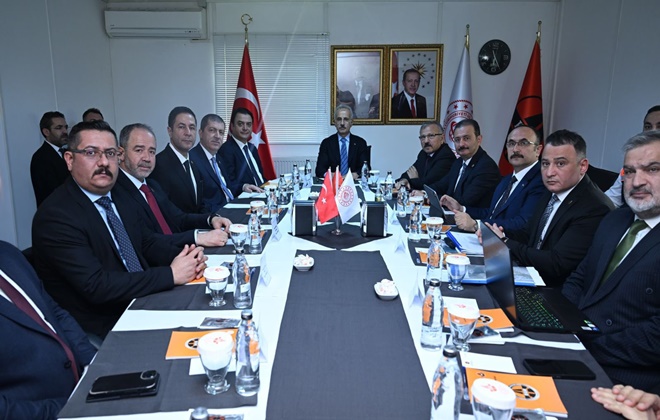
Transport and Infrastructure Minister Abdulkadir Uraloğlu visited the Tokat-Niksar Road worksite on Saturday, May 16, where ongoing construction works are underway, received information about the project, and inspected the works.
Tokat-Niksar Road worksite, Abdulkadir Uraloğlu stated in his remarks to the press that transportation and highway investments mean more than simply building roads; they also help revitalize the economy, accelerate trade, promote tourism, increase employment, and ensure balanced regional development. Uraloğlu emphasized that a modern highway network directly contributes to economic growth in every sector, from production to market access, from agriculture to industry, and from tourism to logistics. He also noted that every kilometer of divided roads saves time and fuel, enhances the competitiveness of businesses, reduces logistics costs, and attracts new investments to the region.
73 Billion Lira Investment in Tokat's Transportation and Communication Infrastructure
Expressing that major projects had been implemented to improve the transportation network and communication infrastructure of Tokat, Abdulkadir Uraloğlu said: “Over the past 24 years, we have invested approximately 73 billion Turkish liras in Tokat's transportation and communication infrastructure. We increased the length of divided roads from 16 kilometers to 311 kilometers by adding 295 kilometers. We also expanded the length of bituminous hot mix asphalt roads from 16 kilometers to 330 kilometers. In both divided roads and hot mix asphalt roads, Tokat is above the national average in Türkiye. We have completed several major highway projects, including the Tokat-Turhal-Amasya Road, Tokat-Çamlıbel Road, Aybastı-Reşadiye Road, Tokat Airport Interchange and Connection Road, and the Tokat Ring Road. We are currently continuing work on seven separate projects, including the Tokat-Niksar Road, the Turhal-Zile-6th Regional Border Road, the Korgan-Çamiçi Road, and the Amasya-Turhal Road project. We have also completed the tender process for the Çamlıbel Tunnel, a long-anticipated project, and construction works will begin soon."
2027 Target for the Tokat–Niksar Road
Emphasizing that the Tokat–Niksar Road is a highly important route connecting Türkiye's north-south corridors, particularly through the Sivas–Yıldızeli–Tokat–Niksar–Akkuş–Ünye line, and providing the region with access to the Black Sea, Abdulkadir Uraloğlu stated that the road would also establish a connection between the Mediterranean and the Black Sea regions.
Uraloğlu continued his remarks by providing details about the project: “We designed the Tokat-Niksar Road as a 49-kilometer divided roads with 2 lanes in each direction, totaling 4 lanes, built to bituminous hot-mix asphalt standards. Within the scope of the project, we are constructing one cut-and-cover tunnel with a length of 1,440 meters, five twin bridges with a total length of 291 meters, two single bridges with a total length of 102 meters, and one interchange measuring 53 meters in length, representing one of the finest examples of modern engineering. In the Dönekse Valley, we are also building a 7-kilometer open drainage channel as part of the project to prevent flooding. We have already completed several major stages of the project. We completed and opened to traffic a 38-kilometer section of the road. We have finalized all bridge construction works and commissioned the Dönekse interchange. We have completed 1,333 meters of our 1,440-meter cut-and-cover tunnel. We will complete the remaining section within this year. We are aiming to finalize all works on the Tokat-Niksar Road by mid-2027."
Tokat–Niksar Road will Contribute to Regional Transportation and Economy
Abdulkadir Uraloğlu stated that upon completion of the project, the existing road, which is currently approximately 54 kilometers long, will be shortened by 5 kilometers, reducing travel time from an average of 40 minutes to 25 minutes. He noted that this would result in annual savings of 1.5 billion Turkish liras, including 1.3 billion liras in time savings and 200 million liras in fuel savings. He also added that the project would contribute to environmental sustainability by reducing carbon emissions caused by vehicle traffic by 10,200 tons
Abdulkadir Uraloğlu stated that this road, which will provide uninterrupted connectivity between the Central Black Sea region and Central Anatolia, the Mediterranean, and Southeastern Anatolia and even the Middle East via Syria's border Gates, will strengthen national and international transportation corridors while increasing the region's trade and tourism volume. He emphasized that problems caused by snow and icing during winter months, particularly in challenging sections such as the Dönekse Crossing, would become a thing of the past, ensuring safe, comfortable, and uninterrupted transportation throughout the year.

