FIRST FIELD APPLICATION OF COOPERATIVE INTELLIGENT TRANSPORT SYSTEM PROJECT: A NEW ERA FOR THE HASDAL JUNCTION AND ISTANBUL AIRPORT CORRIDOR
In Istanbul a significant step has been taken as part of the vision “Where Mobility Meets Intelligence". The first field application of Cooperative Intelligent Transport (C-ITS) on the approximately 40-kilometre corridor between the Hasdal junction and Istanbul Airport. The opening ceremony, held on Friday, 27 March with the participation Minister of Transport and Infrastructure Abdulkadir Uraloğlu, was also attended by the Director General of Highways, Ahmet Gülşen, along with representive of public institutions and organizations.
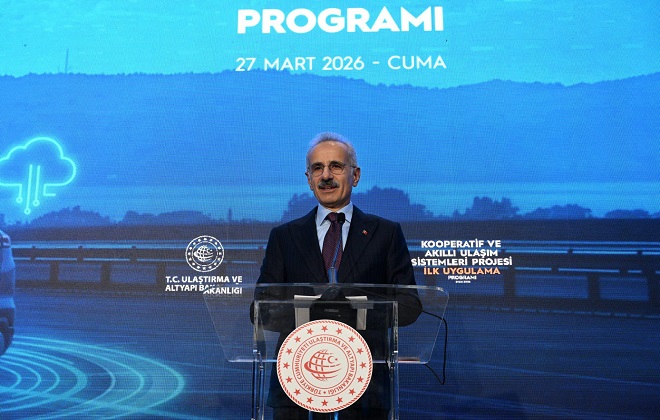
“This Project is a Cornerstone of Türkiye's Intelligent Transportation Vision"
Minister Uraloğlu emphasized that the implementation, which will be the first field example in Türkiye where Cooperative Intelligent Transport Systems are applied holistically under real traffic conditions, is not merely a pilot project: “The project is a cornerstone, a blueprint, and a guide for the future of Türkiye's national intelligent transport vision, adding that each step taken here will strengthen Türkiye's intelligent transport infrastructure and shed light on the future" He stated.
Now Vehicles and Infrastructure will be Interconnected
Minister Uraloğlu stated that transportatin today isn't only about roads and vehichles, noting that an ecosystem in which vehicles communicate intelligently with eachother, infrastructure and everything around them is evolving. He stated that, through this newly developed system, mutual data exchange between vehicles and infrastructure components will be enabled via wireless communication. He noted that, by meeting existing needs, drivers will have access to real-time, location-based information on road, traffic, and environmental conditions, thereby ensuring safer, more comfortable, efficient, and environmentally friendly travel.
Smart Corridor Equipped with Advanced Technology
Elaborating on the implementation of Cooperative Intelligent Transport Systems (C-ITS), which enable communication between vehicles, infrastructure components, and among vehicles themselves, Uraloğlu stated: “Within the corridor where we have initiated the testing and implementation phase, we have integrated the C-ITS infrastructure with conventional Intelligent Transport Systems components such as Variable Message Signs (VMS) and meteorological information stations. We have deployed roadside units (RSUs) and in-vehicle units (IVUs) using domestic and national capabilities. In addition, along the corridor we have commissioned components including camera systems, automatic number plate recognition (ANPR) systems, variable message signs, as well as vehicle detection technologies such as lidar, radar, loop detectors, and Bluetooth-based sensors. The fiber-optic communication infrastructure installed along the corridor, together with the network components, has been configured to support high-capacity data transmission. Furthermore, for the first time in Türkiye's transport sector, we have installed 5G base stations and initiated system optimization studies. Through the 5G communication infrastructure, we will ensure data transmission with low latency and high bandwidth capacity."
Real-Time Alerts and Information for Drivers
Regarding the services to be tested within the corridor, Uraloğlu stated:
“A number of critical applications will be deployed, including the Roadworks Warning Service, Slow or Stationary Vehicle Warning Service, In-Vehicle Traffic Sign and Speed Limit Service, Weather Conditions Warning Service, and Emergency Vehicle Approaching Warning Service. All of this data will be consolidated on a single platform through the Central Software Platform we have developed domestically and nationally. Events will be automatically detected through AI-powered image processing and transmitted to drivers within milliseconds. Road users will also be able to easily access real-time information via our mobile application," he said.
Emphasizing that the system is developed with domestic and national capabilities,He underlined that producing both the software and hardware of high-tech systems using national resources is crucial for strategic independence as well as for strengthening the country's technological capacity. He also noted that the first 5G signal has been activated, adding that this system represents one of its initial applications.
Next Step is Ankara Ring Road
Uraloğlu stated that the second phase of the project, following the first phase, will be implemented in Ankara, adding that the system to be deployed on the Ankara Ring Road will be more comprehensive. He noted that within the scope of the second phase to be implemented on the controlled-access highway consisting of a 110-kilometer main frame, connecting roads, and interchange ramps, additional to the scenarios in the first phase, a wide range of advanced services will be introduced. These include the sharing of traffic accident information, sudden braking alerts, collision risk warnings, traffic congestion alerts, end-of-queue warnings, active protection for pedestrians and cyclists, eco-driving recommendations, emergency vehicle active management, hazardous goods transportation warnings, school zone alerts, and many other advanced applications. He also stated that additional functionalities such as integrated payment and reservation systems for fuel and electric vehicle charging stations, toll collection system integrations, and domestic navigation services are also planned.
Roads Are Evolving into Smart and Dynamic Systems
Speaking at the program, Director General of Highways Ahmet Gülşen stated that road infrastructure is not composed solely of physical components. He noted that, through the integration of technology, highways are being transformed into smarter, more efficient, safer, and more manageable systems. He further stated that intelligent transportation applications in Türkiye, which initially began with traffic monitoring and toll collection systems on motorways, have rapidly advanced through the power of technology and reached a level that is competitive on a global scale.
Türkiye Has Reached a New Milestone in Intelligent Transportation
Gülşen stated that the Cooperative Intelligent Transport Systems Project plays a critical role in Türkiye's transition to connected and autonomous mobility systems. He added that this first implementation in Istanbul is not merely a pilot project, but a significant milestone in the transformation of roads beyond being simple transportation corridors.

